
What are QB Pastors aiming to achieve through their preaching?

For Queensland Baptist (QB) pastors preaching has always been core business. That it remains so is evidenced by the fact that the majority of pastors commit a minimum of one full working day to the task (some more than two!). These many hours of preparation culminate in a message that is delivered in approximately half an hour on Sunday, usually never to be preached again. So, the preaching task is a substantial investment of time and energy, disproportionately weighted against other ministry tasks. Preaching matters to QB pastors.
My PhD research gathered the perspectives of QB pastors using a survey and multiple focus groups. I wanted to understand how pastors approached this important task. I learned of their aims and understandings, their practice and justification of it, issues they encounter and developmental needs they identify.
I have sought to capture the main points of interest in a series of upcoming blog articles, while those willing to extend their reading can refer to the full dissertation text.
The first area of focus is the main aims of pastors. What is it they seeking to achieve through their preaching?
What does the data Reveal?
Findings.
Primarily, most pastors are seeking transformation in their hearers as a result of their preaching. Of the 92 responses received, 58 (or 63%) related to pastors’ longings to see their hearers applying principles that bring life change.
The cognitive impact of the communication of biblical truth is important to them (50 or 54%). However, there is a commonly held desire that information be a means to a greater intended outcome; that of transformation. Pastors are preaching “for change, not to pass on knowledge or information”. They seek “to communicate biblical truth in a way that…people might not just hear information but experience transformation”.
It is noteworthy that pastors cited multiple aims ensuring these figures are not exclusive of one another. In fact, 37 respondents listed their aims as both transformation and communication of truth.
There is recognition that life change cannot be ultimately achieved by the preacher but by the “power of the Holy Spirit through the words of God”. The preacher’s role is “to bring God and the people together, so that God can transform people’s lives”. There is also recognition of transformation as a process, that “I and all listening leave the building a little more like Jesus than when we arrived”. Another aimed for “changed lives…even if it is in tiny steps”.
As pastors communicate biblical truth, they are seeking to guide their hearers into increased understanding. Providing clarity of “the writer’s intended meaning and purpose” permits a grasp of “principles…for our modern day”. Speaking God’s truth is intended not only to convey what the Word of God is saying but what it is and intends to do.
A smaller number of responses drew attention to the importance of both truth and transformation in the corporate dimension. God’s “church [is] to be shaped by His kingdom values”. Two respondents highlighted church unity as among their main aims in preaching. Other aims included hearers encountering God in some way (e.g., experiencing God, hearing from Him) (16). Others emphasised the aim of connecting or engaging effectively with hearers (8), while others sought to exalt Christ (10)
How then do pastors practically work towards achieving these aims?
Application of the Sermon
Responses from focus groups showed that sermon application was the main vehicle used in pursuit of life-change (the essential work of the Holy Spirit notwithstanding). But significantly, pastors also frequently expressed a lack of confidence in developing useful applications.
Most pastors seek “bolt-on” applications, attempting to “land the plane”. However, a range of helpful and diverse models are available (e.g. Doriani, Capill, Chappel). While there isn’t room to develop the discussion adequately here, pastors may benefit from reviewing the relationship between exegesis and application (per Doriani), giving attention to the function of the word (per 2 Timothy 3:16 and 4:2) and allowing that to shape the content and intent of the overall message.
That the word is functional is conceptually well known to pastors. Their emphasis on sermon application is predicated on the understanding that the biblical text is inherently functional. It is replete with action. The familiarity of Hebrews 4:12 should not lessen its relevance here. “For the Word of God is living and active, sharper than any two-edged sword, piercing to the division of soul and of spirit, of joints and of marrow, and discerning the thoughts and intentions of the heart”. The Word is intended to bring the transformational change that QB pastors intend. It is not static or lifeless.
In James 1:22-23, Christian readers are told not only to hear the Word but to do it. Again, the Word is functional and must be applied. If this instruction from James is true for the hearer, it is true also for the preacher. The preacher must not only make the Word hearable but doable. If Jesus example is to be followed, the Word must be faithfully communicated and explained with the implications for the hearer made apparent. It is perhaps not too much of a stretch to say, that in the interests of enhancing the preacher’s ability to do so, signposting the way toward identifying application through the use of simple tools is a beneficial and acceptable service to both preacher and hearer.
The use of frameworks to develop applications may seem unnecessary to more experienced preachers, but the use of simple tools such as the interrogative-based chart below could prove useful.
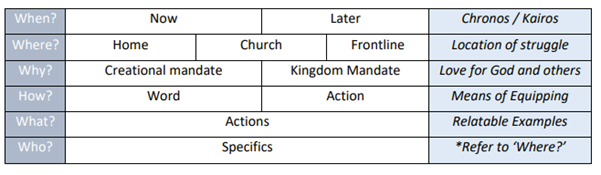
The panels within the chart seek to ground application and provide specificity. The application should speak to the given context, life challenges and opportunities faced by the congregants (individually and collectively). Our first interrogative asks when can this truth be applied? Is it now in the worship service? Is it later at home or at work? Or is the “when” an unknown or as yet unspecified time that requires prior preparation? (e.g. when someone unexpectedly enquires about our faith).
Conclusion
Transformation or life-change is primary in the minds and intentions of most QB pastors. It is what they seek to achieve beyond all else. There is also an encouragingly humble recognition that further skill development, especially with regard to application, could enhance their efforts further. Thankfully, there are some helpful resources and tools to guide pastors in their efforts.
A fuller discussion of Transformational Preaching including a new Sermon Model can be found in Chapter 5 of the PhD dissertation.
Further Reading
Capill, Murray A. The Heart Is the Target: Preaching Practical Application from Every Text. P & R Publishing, 2014.
Chapell, Bryan. Christ-Centered Preaching: Redeeming the Expository Sermon. Vol. 2nd ed. Grand Rapids, Mich: Baker Academic, 2005.
Doriani, Daniel M. Putting the Truth to Work: The theory and practice of biblical application. P & R Pub., 2001.
—
*Quotations within drawn from deidentified participants.
 warrenkercher.com
Leave a comment